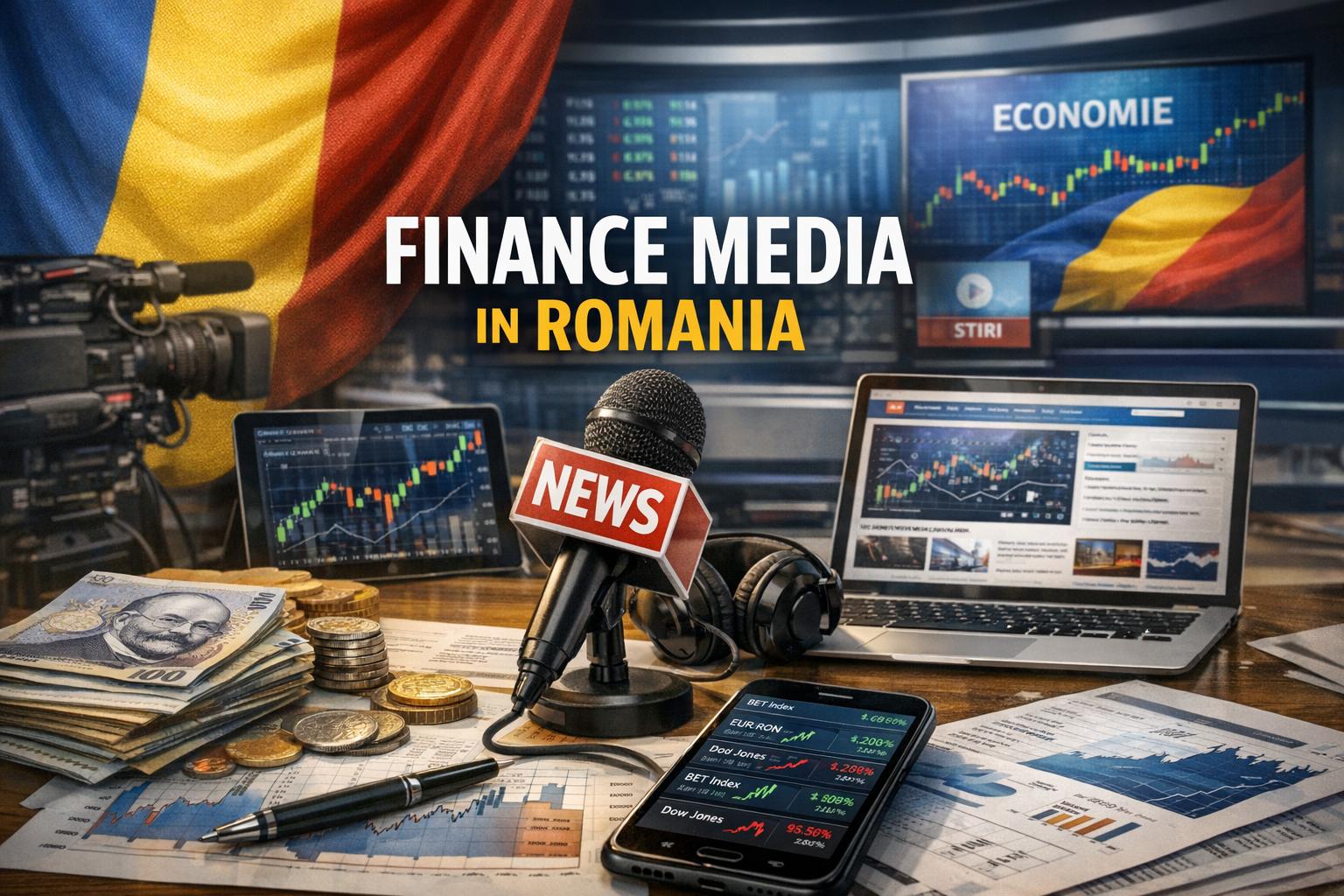
Finance media in Romania has developed alongside the country’s transition from a centralized economy to a market-based system after 1989. Over the past three decades, a diverse ecosystem of newspapers, television channels, radio programs, online platforms, and specialized publications has emerged to cover banking, capital markets, taxation, entrepreneurship, macroeconomic policy, and personal finance. The Romanian finance media landscape reflects broader changes in ownership structures, regulatory frameworks, media consumption habits, and the integration of Romania into the European Union. This article examines the structure, history, major actors, regulatory environment, and current trends shaping finance journalism in Romania.
Historical Background and Post-Communist Transition
Before 1989, Romania operated under a centralized economic model. Media was state-controlled, and financial reporting was limited to official economic planning data, production statistics, and state announcements. Publications such as Scînteia, the official newspaper of the Communist Party, functioned primarily as instruments of state communication. There was no independent coverage of capital markets, private banking, or entrepreneurship because such sectors did not exist in a modern institutional form.
The collapse of the communist regime in December 1989 marked the beginning of economic and institutional transformation. As Romania introduced privatization programs, liberalized prices, and reestablished market mechanisms, the need for economic information expanded rapidly. Entrepreneurs required guidance on taxation and company law. Foreign investors needed insight into legislative reforms and macroeconomic conditions. Newly established banks and financial intermediaries sought channels to communicate with potential clients.
The reopening of the Bucharest Stock Exchange (BVB) in 1995 was a pivotal event. Financial journalism had to explain unfamiliar concepts, including share offerings, brokerage accounts, and dividend policies. Early coverage relied heavily on translated materials and external sources, reflecting limited domestic expertise in capital market reporting. Over time, a cohort of business journalists specialized in company analysis, accounting practices, and financial regulation.
During the late 1990s and early 2000s, macroeconomic volatility, including inflationary pressures and currency depreciation, provided significant content for financial media. The gradual reduction of inflation and the strengthening of fiscal institutions created a more predictable reporting environment. As Romania negotiated accession to the European Union, convergence criteria, structural funds, and regulatory harmonization became central topics of discussion.
Print Media and Business Newspapers
Printed business newspapers played a foundational role in shaping Romania’s finance media landscape. Among the most prominent publications is Ziarul Financiar, launched in 1998 by Mediafax Group. The newspaper quickly became a reference point for daily reporting on banking, corporate transactions, and economic policy. Its website, available at zf.ro, now functions as a continuous news platform, publishing interviews, data-driven analyses, and sector-specific overviews.
Another major publication is Bursa, accessible at bursa.ro. Established in the 1990s, it focuses extensively on stock exchange developments, financial legislation, and investor protection issues. Bursa often publishes detailed commentary on listed companies and debates involving the Financial Supervisory Authority (ASF), pension funds, and brokerage firms.
Weekly and monthly business magazines have complemented daily reporting. Capital, available at capital.ro, is known for company rankings and executive profiles. Business Magazin, which evolved from a print magazine into a predominantly digital format, has long featured analysis of leadership, innovation, and strategic management. These outlets historically provided context beyond daily news cycles, presenting thematic coverage of sectors such as energy, retail, and manufacturing.
Although print circulation has declined as readership shifted online, established print brands continue to influence policy and corporate communities. Print editions are often distributed within business districts and executive networks, maintaining relevance among decision-makers.
Television and Financial Broadcasting
Television has served as a primary communication channel during periods of economic uncertainty or major fiscal reform. General news channels integrate business reporting into broader political coverage, recognizing that fiscal policy and governance are closely linked. Digi24, accessible at digi24.ro, regularly features segments on inflation, public budgets, and central bank decisions. Interviews with government officials and central bank representatives are often broadcast live to provide immediate public clarification.
Antena 3 CNN, at antena3.ro, also covers economic policy within its general news agenda, particularly during budget debates or major legislative initiatives. While political developments dominate programming, macroeconomic analysis remains a constant element.
Dedicated business programs such as Ziarul Financiar TV and specialized discussion panels have provided platforms for executives, economists, and analysts. These formats allow deeper technical discussions compared to general news segments. Topics often include changes in monetary policy by the National Bank of Romania (BNR), trends in real estate financing, or investment activity in technology startups.
During the 2008–2009 global financial crisis, television business coverage expanded significantly as audiences sought real-time information about exchange rate movements and bank stability. A similar intensification occurred during the COVID-19 pandemic and subsequent inflationary period.
Online Platforms and Digital Transformation
The digital transformation has reshaped the structure of Romanian finance media. Increasing broadband access and high smartphone penetration have shifted consumption habits toward continuous online updates. Real-time reporting of stock exchange movements and policy announcements has become standard practice.
In addition to established brands with digital editions, independent platforms such as Economica.net (economica.net) and Wall-Street.ro (wall-street.ro) publish daily news on startups, mergers, executive appointments, and regulatory developments. Their editorial styles emphasize accessibility and concise reporting, often integrating video interviews and event coverage.
Another relevant outlet is Profit.ro (profit.ro), which focuses on corporate transactions, energy markets, and fiscal policy. The platform combines investigative reporting with subscription-based premium content.
Digitalization has facilitated the use of data visualization tools, interactive charts, and newsletters. Many outlets distribute email briefings summarizing key financial developments. Podcasts discussing investment strategies and macroeconomic indicators have gained traction among professional audiences.
Coverage of the Banking Sector
The Romanian banking sector is dominated by subsidiaries of international banking groups alongside major domestic institutions. Financial media closely monitor banks such as Banca Transilvania, BCR, BRD Groupe Société Générale, and Raiffeisen Bank. Quarterly results, lending volumes, and digital banking initiatives receive regular attention.
The National Bank of Romania, whose official site is bnr.ro, plays a central role in economic communication. Monetary policy decisions, inflation reports, and financial stability assessments are widely covered and frequently summarized in accessible formats for general audiences. Press conferences by the BNR Governor are key media events.
Financial reporting also addresses structural topics such as non-performing loan ratios, capital adequacy, and the development of instant payment systems. EU-level regulatory frameworks influence coverage, as Romanian banks comply with European Central Bank guidance and European Banking Authority standards.
Capital Markets and Investment Reporting
The Bucharest Stock Exchange, accessible at bvb.ro, constitutes the focal point of capital markets reporting. Media outlets follow company listings, bond issuances, and dividend distributions. When Romania was promoted to emerging market status by FTSE Russell in 2020, finance publications analyzed implications for foreign institutional investment and index inclusion.
State-owned enterprise listings, including energy utilities, have generated sustained coverage. Journalists examine subscription levels, valuation metrics, and post-listing liquidity. Analysts frequently interpret trading volumes and investor sentiment, particularly during volatile periods.
Venture capital activity has also increased media attention. Romanian-founded technology firms expanding into European and global markets attract coverage regarding funding rounds and cross-border expansion. As startup ecosystems develop in cities such as Bucharest and Cluj-Napoca, investment reporting continues to broaden beyond traditional sectors.
Public Policy, Taxation, and Macroeconomic Reporting
Fiscal policy remains a central topic of Romanian finance journalism. Budget proposals, deficit targets, and public debt trajectories are scrutinized by economic reporters. Government announcements published by the Ministry of Finance and data from Eurostat are regularly cited.
Romania’s compliance with European Union fiscal rules, including Excessive Deficit Procedures, shapes public discourse. Media outlets frequently compare national indicators with EU averages. Inflation dynamics and wage trends are analyzed in the context of energy market fluctuations and regional geopolitical factors.
Tax amendments affecting value-added tax rates, microenterprise regimes, or social contributions receive detailed explanation, as legislative volatility can significantly impact businesses. Financial media often publish interpretative guides to new tax codes.
Personal Finance and Consumer Education
Personal finance journalism has expanded considerably. Articles address mortgage structures, fixed versus variable interest rates, and access to government bond programs aimed at retail investors. The development of private pension schemes under Pillar II and Pillar III frameworks has generated reporting on fund performance and regulatory adjustments.
Outlets increasingly publish explanatory content regarding exchange-traded funds, diversified portfolios, and investment risk. Financial literacy campaigns supported by the banking sector or public institutions are covered extensively, underscoring a broader societal effort to improve understanding of savings and credit management.
The accessibility of online trading platforms has prompted media discussions about retail investor protection, speculative risk, and the importance of transparency in fee structures.
Ownership Structures and Media Independence
Romania’s media ownership landscape is characterized by a combination of domestic entrepreneurs and international investors. Business publications typically rely on advertising from banks, insurance firms, consulting companies, and large corporations. Sponsored conferences and executive events supplement revenue.
The dependence on advertising has periodically raised questions regarding editorial independence. Nevertheless, leading business outlets generally maintain reputations for analytical reporting and reliance on verifiable data sources. Transparency regarding ownership and funding models varies by outlet but is increasingly scrutinized by civil society organizations.
Regulatory Framework
The regulatory environment for finance media intersects with general press legislation and capital market rules. The National Audiovisual Council (CNA) supervises broadcast content, while print and online publications operate under commercial and press law frameworks.
Financial reporting must observe disclosure obligations governed by the Financial Supervisory Authority (ASF), accessible at asfromania.ro. Market abuse regulations and insider information rules shape journalistic practices, particularly when reporting on listed companies or ongoing transactions.
European Union directives, including MiFID II and market transparency regulations, have increased the availability of standardized financial data. This regulatory harmonization has indirectly strengthened analytical depth in Romanian economic reporting.
Current Challenges and Future Developments
Romanian finance media continues to adapt to changing revenue models. Print advertising has contracted, while digital subscription systems are still maturing. Competition from global information platforms and social media channels exerts pressure on domestic publishers.
At the same time, demand for specialized and reliable economic information remains substantial. Data journalism, subscriber-only analysis, and paid conferences represent key strategic directions. The integration of artificial intelligence tools for data processing and automated reporting is gradually emerging.
The trajectory of Romania’s economy—including energy transition initiatives, EU-funded infrastructure projects, and regional investment flows—will likely sustain demand for detailed coverage. The incorporation of environmental, social, and governance (ESG) reporting into corporate communication is also expanding the scope of financial journalism.
Overall, finance media in Romania reflects the country’s broader economic evolution. From limited state-controlled reporting to a multifaceted and increasingly digital ecosystem, financial journalism has become an established component of public discourse. While structural challenges persist, leading outlets continue to inform businesses, investors, and policymakers about developments in domestic and international financial environments.