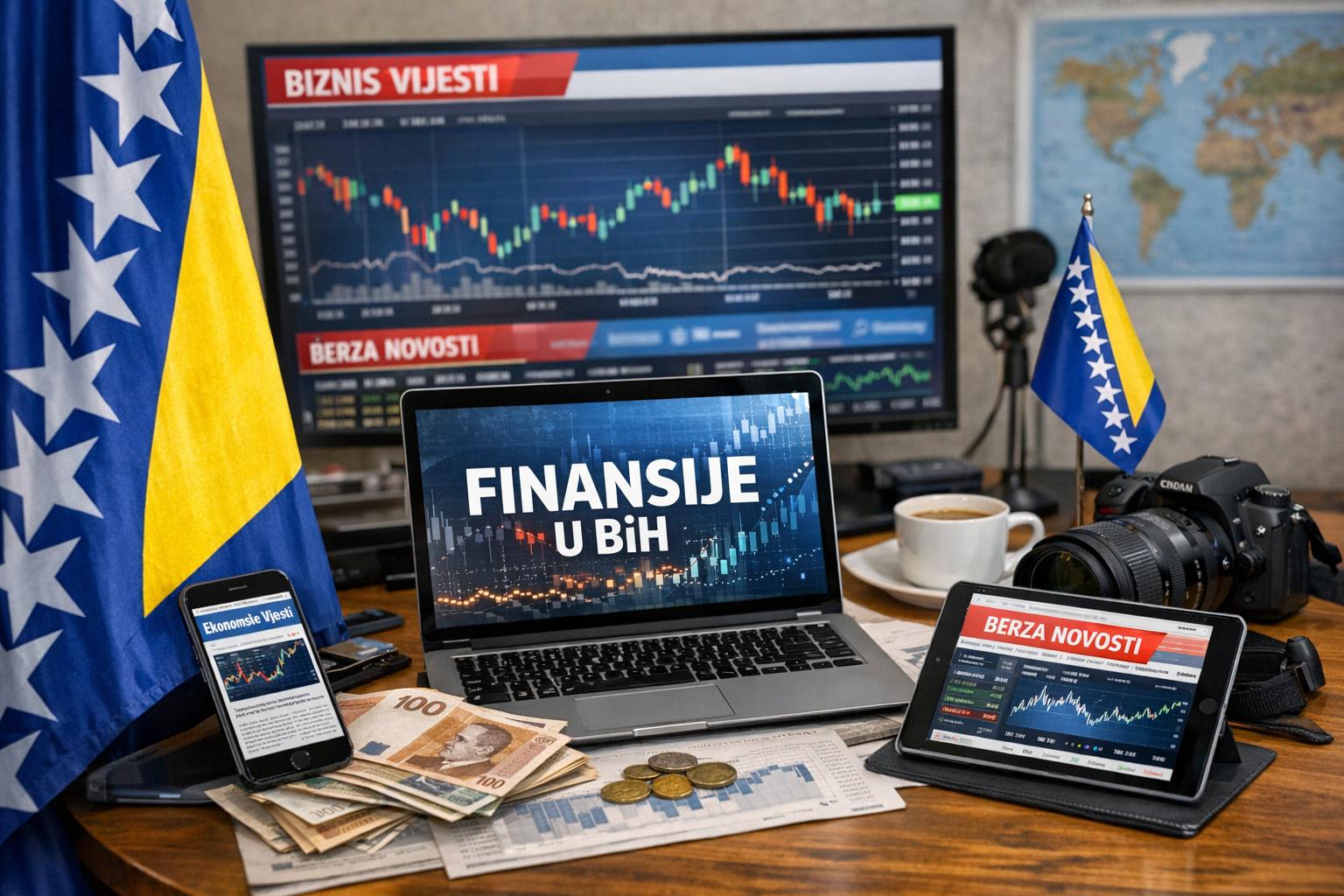
Finance media in Bosnia and Herzegovina has evolved within a complex political, economic, and regulatory environment shaped by the country’s post-war transition and ongoing integration into European structures. The media landscape reflects the broader constitutional framework of the state, composed of the Federation of Bosnia and Herzegovina, Republika Srpska, and the Brčko District. This decentralized system influences regulatory institutions, taxation policies, budget authority, and economic governance, all of which shape how financial news is gathered, interpreted, and presented to the public.
Since the signing of the Dayton Peace Agreement in 1995, Bosnia and Herzegovina has operated under a multilayered system of government with overlapping competencies. In practical terms, this structure generates a highly fragmented flow of financial information. Journalists reporting on public finance must monitor state-level institutions, two entity governments, ten cantonal administrations within the Federation, and numerous municipalities. As a result, financial coverage frequently emphasizes institutional process and fiscal coordination in addition to headline economic indicators.
Financial journalism in Bosnia and Herzegovina addresses banking stability, public debt, taxation reform, labor market conditions, energy investments, foreign trade, and small business development. While the overall scale of the media sector is modest compared to larger European countries, financial reporting carries weight because economic policy often directly affects employment levels, public wages, pensions, and social benefits. In a transitional economy with ongoing structural reforms, accurate and contextualized financial reporting contributes to policy transparency and business confidence.
Structure of the Media Market
The media market in Bosnia and Herzegovina consists of public broadcasters, private television networks, radio stations, print newspapers, and a growing digital news sector. Financial reporting is not typically confined to niche outlets but appears across general news platforms. This structure reflects audience demand: readers and viewers often encounter financial news in connection with political developments, given the strong link between fiscal decisions and government negotiations.
At the state level, the public broadcaster Bosnia and Herzegovina Radio and Television (BHRT) (bhrt.ba) provides news coverage that includes macroeconomic developments, state budgets, and updates from the Central Bank of Bosnia and Herzegovina. At the entity level, Radio-televizija Federacije Bosne i Hercegovine (RTVFBiH) (rtvfbih.ba) and Radio-televizija Republike Srpske (RTRS) (rtrs.tv) cover fiscal legislation, tax administration changes, and infrastructure investment plans within their respective jurisdictions.
Public broadcasters operate under funding structures that combine license fees and public support mechanisms. Financial constraints occasionally limit the scope of investigative economic journalism, yet these outlets remain significant sources of formal economic data announcements and official statements. They frequently report on inflation, exchange rate stability, and public debt management.
Private television stations and radio networks supplement public broadcasting. Their economic segments often focus on consumer prices, fuel costs, energy tariffs, labor market statistics, and announcements by foreign investors. Advertising revenue plays a role in shaping coverage priorities, particularly regarding corporate developments and retail sector dynamics.
Print Media and Business Publications
Print newspapers historically formed the backbone of economic reporting in Bosnia and Herzegovina. Although digital readership has increased, print publications continue to influence financial discourse, particularly among policymakers and established business leaders.
Dnevni Avaz (avaz.ba), Oslobođenje (oslobodjenje.ba), Nezavisne novine (nezavisne.com), and Glas Srpske (glassrpske.com) regularly publish dedicated business sections. These sections address fiscal reforms, entity budget proposals, credit growth trends, public procurement processes, and corporate financial results. Reporting often combines official statements with commentary from domestic economists and representatives of business associations.
Among specialized publications, Poslovne novine (poslovnenovine.ba) focuses primarily on corporate performance, entrepreneurship, and sectoral development. It compiles rankings of successful companies, organizes conferences, and publishes interviews with executives. This integration of reporting and business events illustrates the relatively close relationship between the media and the corporate sector in a small market environment.
Another prominent digital outlet, BiznisInfo.ba (biznisinfo.ba), provides daily updates on regulatory changes, foreign investment activity, and capital market developments. Compared to traditional print publications, digital-native platforms tend to publish financial news more rapidly following central bank announcements or government press conferences.
The Role of Online Media
Online news consumption has expanded significantly over the past decade. Portals such as Klix.ba (klix.ba) maintain business sections that report on public tenders, tax amendments, and international trade statistics. These platforms integrate economic coverage within broader political and social reporting.
Capital.ba (capital.ba) specializes in investigative business journalism, particularly in Republika Srpska. Its coverage has examined public spending patterns, government contracts, and the financial performance of state-owned enterprises. Investigative reporting of this type contributes to public accountability but may also encounter political and legal challenges.
Similarly, Indikator.ba (indikator.ba) provides analysis focused on macroeconomic data and regional economic cooperation. Online portals frequently cite data from the Central Bank of Bosnia and Herzegovina (cbbh.ba) and the Agency for Statistics of Bosnia and Herzegovina (bhas.ba), ensuring that readers have access to official figures regarding GDP growth, inflation, foreign trade, and employment.
The digital format allows outlets to update currency exchange information and commodity price movements frequently. Given that the convertible mark (BAM) operates under a currency board arrangement pegged to the euro, exchange rate reporting typically emphasizes euro-zone developments and European Central Bank policy decisions.
Broadcast Media and Economic Programming
Television maintains considerable influence, especially among audiences less engaged with digital media. Economic stories are generally incorporated into prime-time news bulletins. Coverage often includes discussions with finance ministers, central bank representatives, and leaders of business chambers.
Some broadcasters produce specialized programs addressing agriculture financing, export promotion, and tourism development. These segments may analyze subsidy mechanisms, rural credit lines, or external trade agreements. While these programs are not exclusively financial in focus, they contribute to broader economic literacy by explaining how policies affect commercial activity.
Radio continues to play a role in disseminating information about fuel prices, pension adjustments, and agricultural support measures. In rural areas where internet penetration may be limited, radio announcements remain a practical channel for distributing economic information.
Financial Regulation and Reporting Standards
The financial media sector operates under oversight from the Communications Regulatory Agency (rak.ba) for broadcasting, while print and online outlets are subject to defamation law and general legal standards. Financial reporting often involves interpretation of complex legislation, including entity-level banking regulations and tax codes.
The Central Bank of Bosnia and Herzegovina maintains monetary stability through its currency board arrangement, which requires full backing of the domestic currency with foreign reserves. Media discourse frequently references reserve levels, inflation control, and alignment with euro-area developments.
Banking supervision occurs at the entity level through the Banking Agency of the Federation of Bosnia and Herzegovina and the Banking Agency of Republika Srpska. Media outlets publish data on capital adequacy ratios, loan portfolio structures, and non-performing loan trends. Reporting quality varies across outlets; some provide detailed data interpretation, while others relay official statements with limited analysis.
Ownership and Political Influence
Ownership structures in Bosnia and Herzegovina often intersect with political or commercial interests. Private media companies may rely on advertising from state-owned enterprises or government bodies. This reliance can affect editorial emphasis, particularly when reporting on privatization, concession agreements, or public sector borrowing.
International organizations, including the Organization for Security and Co-operation in Europe (OSCE) and the European Union Delegation to Bosnia and Herzegovina, have supported initiatives promoting media transparency and professional standards. As EU accession negotiations progress, financial transparency and anti-corruption reporting remain central themes within journalism.
Coverage of Banking and Capital Markets
The banking sector is largely foreign-owned, with subsidiaries of Austrian and Italian banking groups maintaining a strong presence. Financial media tracks credit expansion, interest rate movements, and regulatory adjustments affecting consumer lending and corporate financing.
Capital markets operate through the Sarajevo Stock Exchange (sase.ba) and the Banja Luka Stock Exchange (blberza.com). Trading volumes are limited relative to major European exchanges, and coverage often focuses on government bond issuances and privatization-era shareholdings. Specialized brokerage firms publish additional analysis for institutional and individual investors.
Public Finance and Budget Reporting
Public finance forms a central strand of financial journalism due to the country’s multilayered governance system. Media coverage follows draft budgets at the state and entity levels, along with cantonal and municipal allocations. Discussions of value-added tax distribution, excise duties, and infrastructure financing frequently enter public debate.
Negotiations with the International Monetary Fund and the World Bank receive extensive reporting. Journalists examine the fiscal conditions attached to financial assistance programs, including structural reforms aimed at improving tax administration and public sector efficiency.
Foreign Investment and International Trade
The European Union is Bosnia and Herzegovina’s largest trading partner, and export data related to EU markets are widely reported. Media outlets track trade balances, customs regulations, and alignment with EU product standards. Investment from neighboring countries, Turkey, and other regions is also covered, particularly in the energy and manufacturing sectors.
Infrastructure initiatives financed by the European Investment Bank and the European Bank for Reconstruction and Development are commonly featured in economic reporting. Journalists analyze project financing terms and long-term fiscal implications.
Entrepreneurship and Small Business Reporting
Small and medium-sized enterprises represent a substantial portion of economic activity. Media coverage highlights manufacturing exporters, agricultural cooperatives, and technology companies. The IT outsourcing industry has received sustained attention due to its export potential and integration into regional markets.
Digital platforms publish interviews with startup founders and diaspora investors who support domestic ventures. Although venture capital remains limited, regional accelerator programs and innovation grants receive increasing visibility in business reporting.
Financial Literacy and Public Engagement
Financial literacy initiatives are gradually expanding. Media outlets publish explanatory articles outlining loan conditions, savings instruments, and pension system reforms. During periods of price instability, coverage often explains inflation drivers and household budgeting considerations.
The Central Bank of Bosnia and Herzegovina and commercial banks collaborate with media to promote awareness of digital banking security and consumer rights. Such engagement reflects recognition that effective financial communication strengthens overall financial stability.
Challenges Facing Financial Media
Structural challenges include limited advertising revenue, fragmented audiences, and political polarization. Newsrooms frequently operate with small teams, and specialized financial expertise can be limited. Journalists often balance multiple reporting responsibilities, which may constrain in-depth analysis of complex fiscal matters.
The digital shift has increased competition for attention while reducing subscription income. Many readers expect immediate access to financial updates without paywalls, requiring outlets to adjust business models accordingly. Sustainability and professional development remain ongoing priorities within the sector.
Regional and European Context
Bosnia and Herzegovina’s economic reporting is closely connected to developments in Croatia, Serbia, and Slovenia, reflecting trade and investment linkages across the Western Balkans. Regional financial trends frequently appear alongside domestic statistics.
The path toward European Union membership continues to influence financial journalism. Legislative harmonization, anti-corruption measures, and regulatory convergence are recurrent subjects. Media outlets monitor progress reports issued by European institutions and assess their implications for fiscal governance and market regulation.
Overall, financial media in Bosnia and Herzegovina operates within a distinctive combination of decentralized governance, transitional economic reform, and European integration. Through public broadcasters, print outlets, and digital platforms, financial journalism contributes to transparency in banking, public finance, trade, and entrepreneurship. Its continued development is linked to institutional reform, market sustainability, and the broader trajectory of economic modernization.