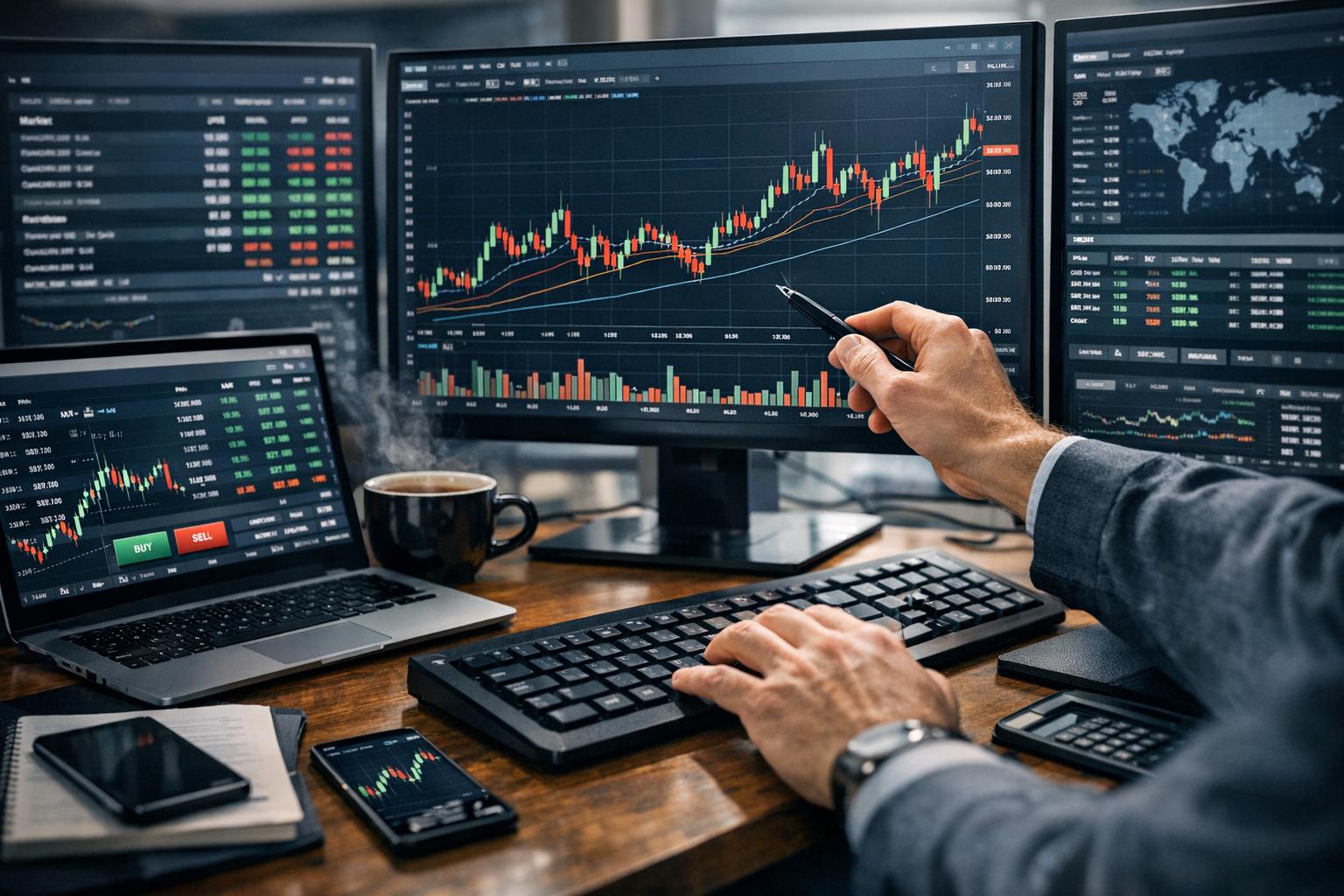
Trading refers to the structured process of buying and selling financial instruments with the objective of generating profit. It operates across various markets, including equities, foreign exchange, commodities, derivatives, fixed income securities, and digital assets. Unlike traditional long-term investing, which often emphasizes gradual wealth accumulation through dividends, interest income, or asset appreciation over years or decades, trading generally focuses on shorter time horizons and the active management of price fluctuations. Market participants range from individual retail traders operating through online brokerage accounts to large institutional firms deploying sophisticated, algorithm-driven infrastructure.
The global trading ecosystem relies on organized exchanges and over-the-counter networks that facilitate liquidity and price discovery. Exchanges provide centralized order books where buyers and sellers submit bids and offers, while over-the-counter markets enable decentralized negotiation between counterparties. Through these mechanisms, prices are continuously formed in response to order flow and information. The resulting market price at any moment reflects aggregated expectations, available data, perceived risk, and prevailing sentiment.
Technological evolution has transformed trading from open outcry pits and manual ticket processing into predominantly electronic environments. Modern platforms process high volumes of transactions within milliseconds, enabling near-instantaneous execution. Continuous access to data, charting systems, news feeds, and order management tools has significantly increased market accessibility for both institutional and retail participants.
Foundations of Financial Markets
Financial markets exist to allocate capital efficiently between those who seek funding and those who provide it. In equity markets, corporations issue shares to raise capital for expansion, research, infrastructure, or operational needs. Investors and traders subsequently exchange those shares based on expectations regarding corporate earnings, market position, and broader economic conditions. The price of a stock therefore incorporates both tangible financial results and forward-looking projections.
Bond markets facilitate the issuance and trading of debt securities. Governments, municipalities, and corporations borrow funds by issuing bonds with defined maturities and coupon payments. Traders in bond markets assess interest rate expectations, creditworthiness, and macroeconomic stability. Bond pricing is closely linked to prevailing yields, which move inversely to prices and respond directly to central bank policy and inflation trends.
The foreign exchange market, commonly known as Forex, represents the largest and most liquid financial market globally. Currencies are traded in pairs, reflecting the relative value of one currency against another. Exchange rates fluctuate in response to economic growth differentials, monetary policy decisions, geopolitical developments, and international trade flows. Unlike equity markets, Forex operates continuously across global financial centers, providing near 24-hour trading during weekdays.
Commodity markets encompass physical goods such as energy products, agricultural outputs, and industrial metals. Prices are influenced by production levels, global demand, logistical constraints, seasonal patterns, and geopolitical factors. Commodity trading often relies on futures contracts that standardize quantity, quality, and delivery dates to ensure orderly exchange operations.
While some markets operate on centralized exchanges such as the New York Stock Exchange or the Chicago Mercantile Exchange, others function primarily through decentralized networks. Clearinghouses play a critical role by acting as intermediaries between buyers and sellers, reducing counterparty risk and ensuring settlement integrity. Regulatory authorities oversee these structures to promote fairness, transparency, and systemic stability.
Market Participants and Their Roles
Participants in trading environments vary widely in purpose, capital resources, and operational scale. Retail traders typically trade for personal accounts, employing discretionary decision-making or automated tools provided through brokerage platforms. Institutional participants include hedge funds, mutual funds, pension funds, proprietary trading firms, and investment banks.
Market makers occupy a specialized function. They provide liquidity by continuously quoting bid and ask prices, profiting from the spread between them. Their presence enhances market efficiency by smoothing order imbalances and reducing transaction costs for other participants.
Hedgers participate in markets primarily to mitigate business risk rather than to speculate. An airline company, for example, may use fuel futures to stabilize future fuel costs. Exporters and multinational corporations often hedge foreign exchange exposure to reduce uncertainty in cross-border revenue.
Speculators assume risk in anticipation of price movement. Their activities contribute to liquidity and price discovery. Arbitrageurs, meanwhile, seek to exploit temporary price discrepancies between related instruments or markets, helping align valuations across trading venues.
Types of Trading Approaches
Trading strategies are commonly categorized by time horizon and execution methodology. Day trading involves opening and closing positions within a single trading session. Practitioners of this approach avoid overnight market exposure, focusing instead on intraday volatility generated by news events, order imbalances, or technical price patterns.
Swing trading extends over multiple days or weeks. Swing traders aim to capture intermediate price moves within broader trends. They often combine technical analysis with macroeconomic context to identify entry and exit levels.
Position trading spans longer durations, sometimes months. Although it resembles investing in timeframe, it retains an emphasis on structured trade planning, predefined exit rules, and continuous reassessment of risk. Position traders respond to sustained macroeconomic shifts, sector rotation, or long-term valuation distortions.
In addition to time-based classifications, trading strategies can be divided into discretionary and systematic frameworks. Discretionary trading relies on human judgment and interpretive skills. The trader analyzes charts, earnings reports, economic indicators, or geopolitical developments and decides whether to initiate or close positions. Systematic trading, by contrast, uses rule-based algorithms that generate signals automatically according to predefined statistical or mathematical criteria.
Technical and Fundamental Analysis
Two principal analytical methodologies underpin most trading decisions: technical analysis and fundamental analysis. Technical analysis focuses on price behavior itself. It assumes that historical data contains patterns that may repeat under similar conditions. Charts display candlestick formations, trends, and support or resistance levels. Indicators such as moving averages smooth price series, while oscillators attempt to measure momentum or overbought and oversold conditions.
Volume analysis further complements price study by revealing participation intensity. Rising prices accompanied by increased volume may indicate stronger conviction, whereas divergences can signal potential reversals. Technical frameworks are widely applied in shorter-term trading due to their emphasis on timing and execution.
Fundamental analysis evaluates the intrinsic or relative value of an instrument. In equity markets, this involves examining revenue growth, profit margins, debt levels, competitive advantages, and management effectiveness. Analysts may employ valuation ratios such as price-to-earnings or discounted cash flow models to estimate fair value.
In currency markets, fundamental analysis centers on macroeconomic indicators including inflation, employment data, GDP growth, and interest rate policy. Central bank communications play a pivotal role in shaping expectations. Commodity traders assess supply-demand balances, inventory data, and global consumption trends.
Many market participants integrate both approaches. Fundamental insights may determine directional bias, while technical analysis refines entry timing and risk parameters. The integration of multiple analytical perspectives can produce a more comprehensive decision-making framework.
Risk Management Principles
Effective trading depends on disciplined risk management. Financial markets are inherently uncertain, and losses are an unavoidable component of participation. Structured risk policies reduce the probability of severe capital erosion and contribute to longevity in trading activities.
Position sizing determines the proportion of capital allocated to each trade. Rather than risking large percentages of total equity on single positions, many traders limit exposure to a small, predefined fraction. This approach recognizes that even well-researched trades may result in loss due to unpredictable events.
Stop-loss orders serve as protective mechanisms. By specifying a price at which a losing trade will be automatically closed, traders establish clear risk boundaries. Trailing stops may adjust dynamically as prices move favorably, preserving accumulated gains while limiting downside reversal risk.
Risk-reward evaluation is integral to trade selection. A strategy may maintain overall profitability if average gains exceed average losses, even when the proportion of losing trades is substantial. Expected value calculations help quantify this relationship.
Beyond numerical controls, consistent execution is essential. Deviating from predefined plans can introduce variability that undermines performance analysis. Maintaining trading journals, reviewing performance metrics, and adhering to disciplined routines contribute to structured risk oversight.
Leverage and Margin
Leverage enables traders to control positions larger than their deposited capital. Through margin accounts, brokers extend credit against collateral. For example, a leverage ratio of 10:1 allows control of an exposure ten times larger than the trader’s initial margin requirement.
While leverage enhances potential returns, it proportionally magnifies adverse price movements. Small fluctuations can translate into significant percentage changes relative to invested capital. If losses reduce equity below required thresholds, brokers may issue margin calls or automatically liquidate positions to protect against further deterioration.
Regulatory authorities frequently impose leverage caps to reduce systemic vulnerability. These restrictions vary across asset classes and jurisdictions. Institutional participants often operate under internal risk models that determine allowable leverage based on volatility, liquidity, and capital adequacy assessments.
Liquidity, Volatility, and Market Conditions
Liquidity describes the ability to buy or sell an instrument without materially affecting its price. Highly liquid markets, such as major currency pairs or widely traded equities, display tight bid-ask spreads and deep order books. Reduced liquidity may occur during off-peak hours, holidays, or periods of uncertainty.
Volatility quantifies price variability over a defined period. Rising volatility expands potential opportunity but increases uncertainty. Scheduled economic releases, corporate earnings announcements, and geopolitical developments frequently generate short-term volatility spikes. Traders often adapt by adjusting position sizes or widening stop parameters.
Volatility metrics are embedded within options pricing models and risk calculations. Historical volatility measures past movements, while implied volatility reflects expectations embedded in derivative prices.
The Role of Technology and Data
Electronic trading infrastructure underpins modern markets. Platforms provide integrated charting tools, automated order routing, and real-time analytics. Co-location services allow institutional firms to place servers near exchange data centers to reduce latency.
Algorithmic trading systems execute strategies based on quantitative instructions. These algorithms may exploit statistical arbitrage, market-making spreads, or trend-following signals. High-frequency trading represents an advanced subset characterized by extremely short holding periods and large order volumes.
Data science applications continue to expand. Machine learning models analyze extensive datasets, identifying correlations among asset classes, sentiment indicators, and alternative data sources such as satellite imagery or supply chain metrics. Although quantitative methods can enhance predictive capacity, they also introduce technical complexity and model risk.
Regulatory Structure and Compliance
Financial markets function within structured regulatory frameworks. Oversight bodies establish rules designed to maintain transparency, prevent manipulation, and safeguard client assets. Requirements typically address capital adequacy, segregation of client funds, reporting obligations, and disclosures regarding risk.
Anti-money laundering standards and know-your-customer procedures support the integrity of financial systems. Exchanges and brokers implement surveillance systems to detect irregular trading patterns. Cross-border cooperation among regulators has increased due to the globalized nature of capital flows.
Institutional trading firms maintain compliance departments responsible for monitoring adherence to regulations and internal policies. Robust compliance infrastructure reduces operational and reputational risk.
Psychology and Behavioral Considerations
Trading outcomes are influenced not only by analytical skill but also by cognitive and behavioral factors. Research in behavioral finance identifies systematic biases that affect decision-making under uncertainty. Loss aversion may encourage premature exit from profitable trades or delayed closure of losing positions. Overconfidence can lead to excessive risk exposure following success.
Confirmation bias reinforces existing beliefs, potentially distorting interpretation of new information. Structured decision frameworks, performance tracking, and objective criteria help mitigate these tendencies. Professional environments often separate execution and risk oversight roles to enhance objectivity.
Derivatives and Complex Instruments
Derivatives derive value from underlying assets. Futures, options, swaps, and structured products enable exposure to price movements without direct ownership of the asset. These instruments support speculation, hedging, and yield enhancement strategies.
Options pricing depends on variables including time to expiration, strike price, interest rates, and implied volatility. Futures contracts standardize obligations for future settlement. Swaps allow counterparties to exchange cash flow streams, often to manage interest rate or currency risk.
Due to embedded leverage and structural complexity, derivatives require comprehensive understanding of payoff profiles and risk sensitivities. Greeks such as delta, gamma, and theta quantify exposure to price, volatility, and time changes, assisting in portfolio management.
Globalization and Interconnected Dynamics
Modern markets operate within an interconnected global system. Capital flows across borders with limited friction, linking asset classes and regions. Changes in monetary policy by a major central bank can influence exchange rates, bond yields, and equity valuations simultaneously.
Macroeconomic developments, trade relationships, and geopolitical tensions may generate cross-asset correlations. Traders often monitor multiple markets to assess relative value and potential contagion effects. Understanding global interdependence is essential for contextualizing local price movements.
Performance Measurement and Evaluation
Assessing trading performance extends beyond measuring net profit. Drawdown analysis evaluates the magnitude and duration of capital declines. Risk-adjusted metrics such as the Sharpe ratio compare returns relative to volatility. The Sortino ratio refines this by focusing on downside deviation.
Consistency of returns, adherence to strategy, and stability across varying market conditions are frequently emphasized over short-lived gains. Detailed record-keeping allows traders to identify strengths, weaknesses, and structural inefficiencies within their approach. Benchmark comparisons provide context relative to passive alternatives or sector indices.
Conclusion
Trading represents a structured engagement with dynamic financial markets. It integrates analysis, execution, risk control, and continuous evaluation. Participants operate across equities, currencies, commodities, fixed income securities, and derivatives, utilizing technological platforms that facilitate global access.
Sustainable participation depends on disciplined risk management, measured application of leverage, analytical rigor, and structured review processes. As financial systems evolve in response to regulatory refinement, technological advancement, and macroeconomic change, trading methodologies continue to adapt. A systematic framework grounded in clearly defined rules and objective assessment remains central to long-term effectiveness within complex and interconnected markets.