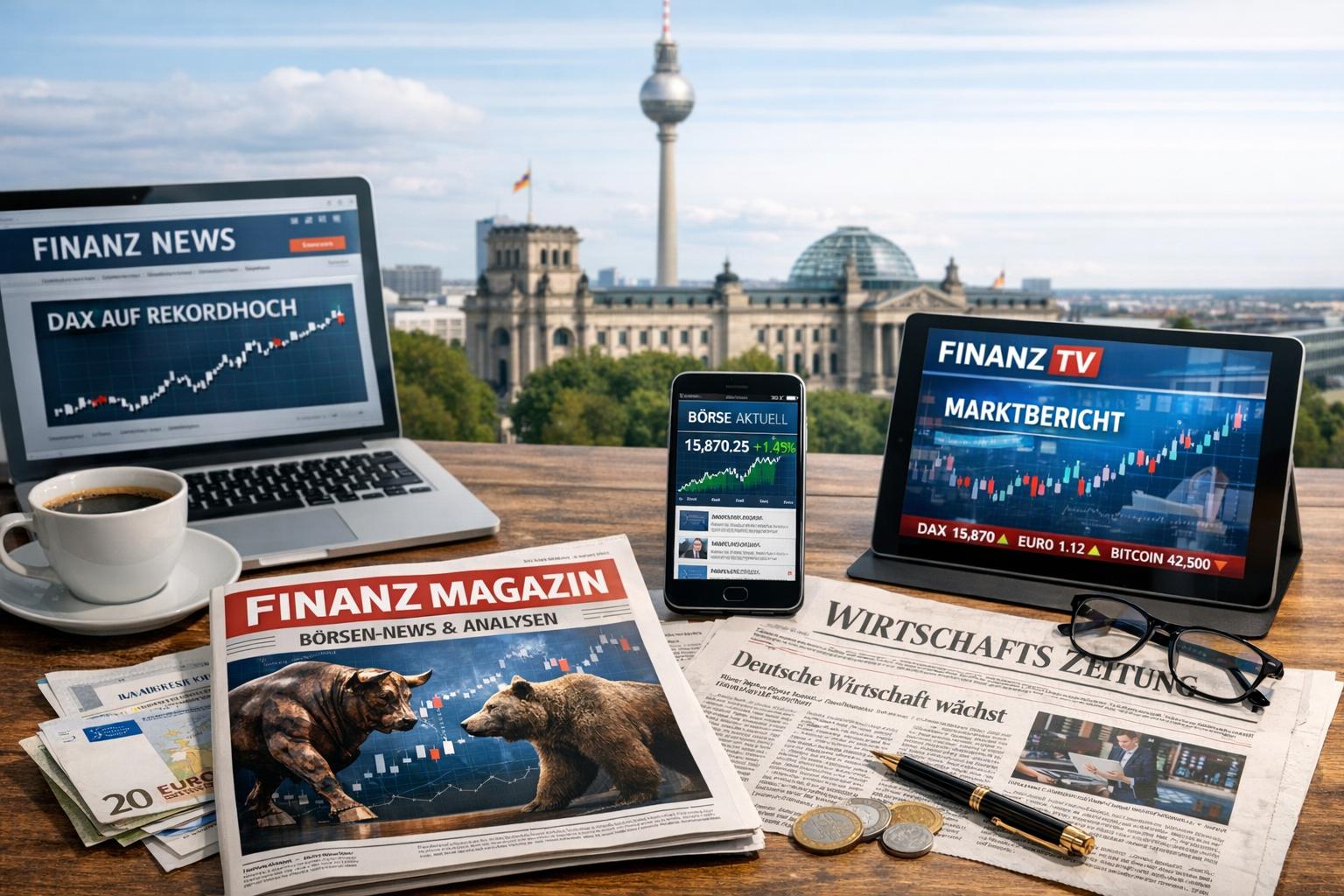
Structure and Role of Finance Media in Germany
Finance media in Germany forms a distinct segment within the broader media landscape, combining elements of journalism, economic research, and investor communication. It encompasses daily newspapers, weekly magazines, specialist newsletters, academic-style research publications, television programming, podcasts, digital-native platforms, and data-focused market services. The primary function of this media ecosystem is to provide reliable information on capital markets, corporate developments, macroeconomic trends, regulatory changes, monetary policy, and personal finance.
Germany’s role as the largest economy in the European Union and as host to the Frankfurt Stock Exchange and the European Central Bank (ECB) contributes to a highly developed financial information infrastructure. Reporting extends beyond domestic developments to include the euro area, the United States, and Asia, acknowledging Germany’s export-oriented economy and integration into global supply chains. The audience is diversified. It includes retail investors, corporate managers, board members, institutional investors, academics, policymakers, consultants, and students of economics and finance.
German finance media operates within a regulatory culture that emphasizes editorial independence, factual precision, and transparency. Unlike more commercially aggressive media environments, German financial journalism traditionally aligns itself with a public-interest understanding of economic reporting. This orientation influences tone, depth of analysis, and the boundary between commentary and advertising.
Historical Development
The foundations of financial journalism in Germany can be traced to the 19th century, when trading bulletins and exchange reports circulated in commercial hubs such as Frankfurt, Hamburg, and Berlin. These early publications concentrated on commodity prices, shipping information, bond issuances, and credit developments. Reporting was closely linked to merchant activity and served practical trading purposes.
In the early 20th century, industrialization and the rise of joint-stock companies expanded the scope of economic reporting. Newspapers began to cover industrial production, banking developments, and fiscal policy debates. After World War II, the division of Germany produced two separate media systems. In West Germany, the social market economy fostered by Ludwig Erhard encouraged capital markets and private enterprise, gradually strengthening interest in economic journalism. The Wirtschaftswunder period increased public engagement with industry, exports, and corporate performance.
The expansion of equity markets in the 1980s and 1990s was a turning point. The establishment of the DAX index in 1988 created a visible benchmark for German blue-chip companies. Coverage of index movements, earnings seasons, and international market dynamics became more systematic. Following reunification in 1990, reporting also addressed privatization in Eastern Germany, state-owned enterprise restructuring, and cross-border investment flows.
The late 1990s technology boom, coupled with the launch of the Neuer Markt for growth companies, triggered a surge in retail investor participation. Financial journalism adapted by introducing more market-oriented content and investor education. The subsequent collapse of the Neuer Markt reinforced a cautious reporting style and more rigorous scrutiny of corporate disclosures.
The digital revolution further transformed distribution. Online portals emerged in the early 2000s, providing near real-time updates. Print publications increasingly integrated digital offerings, altering subscription models and newsroom workflows.
Major Print and Digital Publications
Germany maintains several influential publications with strong business and financial coverage. Among the most prominent is Handelsblatt, widely regarded as the country’s leading business daily. It provides corporate reporting, policy analysis, interviews, investigative pieces, and market data. Handelsblatt maintains a substantial digital presence and operates a subscription model that includes premium content and newsletters. Its reporting extends to global financial centers and European regulatory institutions. More information is available at Handelsblatt.
The weekly magazine WirtschaftsWoche focuses on in-depth analysis, corporate leadership profiles, investment themes, and industry reports. It often presents extended features exploring strategic decisions within German and international companies. Its coverage bridges management issues and financial market implications. The publication’s digital platform complements its print edition. See WirtschaftsWoche.
General newspapers also maintain substantial economic desks. The Frankfurter Allgemeine Zeitung (FAZ) provides detailed market reports and policy commentary, reflecting Frankfurt’s financial status. The FAZ publishes dedicated market pages, analytical columns, and international perspectives. Its website is accessible at FAZ.
Süddeutsche Zeitung, headquartered in Munich, integrates economic reporting with investigative journalism and political analysis. It examines corporate governance, regulatory enforcement, and fiscal developments. Information can be found at Süddeutsche Zeitung.
Die Welt, based in Berlin, combines political and market coverage, addressing fiscal policy, global trade, and financial markets. Its digital and print editions are available via Die Welt.
Beyond traditional publishers, digital-native platforms play a central role in distributing market information. Finanznachrichten.de aggregates corporate announcements and analyst commentary. Portals such as Onvista and Ariva.de provide stock quotes, charts, screening tools, and discussion forums. These platforms often generate revenue through advertising, premium features, and brokerage partnerships. Their services cater particularly to active retail investors seeking timely price information and peer discussion.
Broadcast and Multimedia Finance Reporting
Public broadcasters form a cornerstone of Germany’s media system. ARD and ZDF integrate financial reporting into mainstream news programming. ARD’s exchange reporting from Frankfurt has long been a consistent feature of evening broadcasts. Daily segments summarize DAX performance, significant corporate news, commodity price changes, and currency movements.
Private broadcasters such as n-tv and Welt TV provide rolling news coverage that includes market updates, interviews with economists and fund managers, and live reporting from business conferences. Their formats allow immediate reaction to monetary policy decisions or geopolitical developments.
Podcasts and digital streaming formats have expanded considerably. Many established publications now produce regular finance podcasts analyzing market trends, interest rate outlooks, and sector developments. These programs allow for extended discussion beyond the time constraints of television. They also reach younger professional audiences accustomed to on-demand content. Video interviews streamed via websites and platforms such as YouTube supplement written journalism, broadening the distribution channels for financial expertise.
Regulatory Environment and Journalistic Standards
Financial journalism in Germany is protected by Article 5 of the Grundgesetz, guaranteeing freedom of expression and freedom of the press. However, this freedom operates within a legal environment that includes market-related constraints. Reporting must not involve defamation, deliberate misinformation, or content that could constitute market manipulation.
The German Press Council (Deutscher Presserat) enforces compliance with the Press Code, which establishes standards for accuracy, transparency, and the separation of advertising from editorial content. Financial reporting is particularly sensitive because inaccurate information about publicly traded companies may affect share prices.
The Federal Financial Supervisory Authority (BaFin) oversees market integrity. While BaFin does not regulate journalism as such, it monitors potential attempts to manipulate markets through false or misleading public statements. Journalists and publishers must exercise caution in reporting rumors or speculative claims related to corporate actions.
Disclosure of conflicts of interest enhances transparency. Publications commonly state whether authors hold shares or financial interests related to the companies discussed. Sponsored content is labeled clearly to distinguish it from independent editorial reporting.
Coverage Areas and Editorial Focus
Corporate reporting is a central element of German finance media. Earnings announcements, mergers and acquisitions, insolvencies, management changes, and strategic shifts are covered in detail. Companies listed on the DAX, MDAX, and SDAX receive systematic attention, particularly during quarterly reporting seasons.
Macroeconomic analysis forms another pillar. Publications cover developments in gross domestic product, inflation rates, labor market indicators, industrial production figures, and trade balances. Because Germany is heavily export-oriented, developments in the United States, China, and other trading partners are closely monitored.
Monetary policy decisions of the European Central Bank receive sustained attention. Changes in key interest rates, asset purchase programs, and forward guidance are analyzed for their influence on bond markets, equity valuations, real estate financing, and currency exchange rates. Fiscal policy debates within Germany and the European Union also receive extensive examination, particularly in relation to debt rules and public investment strategies.
Personal finance reporting addresses retirement planning, taxation, insurance frameworks, and retail investment vehicles such as ETFs and mutual funds. Given demographic trends and the importance of occupational and statutory pension systems, long-term savings structures frequently feature in explanatory articles.
Institutional and Retail Audiences
German finance media serves both institutional professionals and private investors. Institutional audiences seek granular data, regulatory updates, and industry-specific reporting. Specialized newsletters, conference briefings, and subscription-only research products address this segment.
Retail investors represent a broader readership. Historically, German households demonstrated conservative savings patterns favoring bank deposits and insurance contracts. Prolonged low interest rate phases during the 2010s shifted attention toward equity markets and exchange-traded funds. Media outlets responded by expanding educational content explaining diversification, compound interest, and long-term asset allocation principles.
The rise of digital brokerages and app-based trading platforms generated demand for agile reporting. Market-moving developments now circulate rapidly, requiring editorial teams to balance speed with verification.
Digital Transformation and Revenue Models
Print circulation has gradually declined across Germany, including in the business press. Publishers have implemented digital subscription models that provide tiered access to premium articles, e-papers, newsletters, and archives. Metered paywalls allow casual visitors limited access before requiring payment.
Advertising revenue remains relevant, particularly for financial data portals with high traffic volumes. However, editorial independence is safeguarded through strict labeling of sponsored materials. Native advertising formats are typically marked to ensure transparency.
Events and conferences represent an additional business model component. Business summits organized by financial publications gather executives, policymakers, and researchers for panel discussions and networking. These events reinforce brand authority and create supplementary income streams.
Automation technologies have entered newsroom operations. Data-driven templates enable automated summaries of earnings reports or trading sessions, freeing journalists to conduct investigative research or produce analytical features. Artificial intelligence tools assist in data visualization and pattern recognition but remain subject to editorial oversight.
Financial Centers and Geographic Distribution
Frankfurt am Main is Germany’s primary financial center. It hosts the Frankfurt Stock Exchange, operated by Deutsche Börse, and serves as headquarters for numerous financial institutions. The European Central Bank and the Deutsche Bundesbank are based there, ensuring sustained journalistic attention to the city’s institutions.
Düsseldorf houses Handelsblatt, while Munich and Berlin play substantial roles in publishing and policy reporting. Berlin’s political significance ensures strong coverage of fiscal legislation, coalition negotiations, and regulatory reforms. The decentralized federal structure of Germany is mirrored in its media landscape, with regional publishing hubs contributing perspectives to national financial coverage.
Integration with Academic and Research Institutions
Economic research institutes exert measurable influence on financial reporting. The Ifo Institute in Munich publishes widely cited business climate indices. The German Institute for Economic Research (DIW Berlin) provides data-driven policy analysis, accessible at DIW Berlin. The IfW Kiel Institute for the World Economy contributes forecasts and global trade assessments.
Statistical releases from the Federal Statistical Office (Destatis), available at Destatis, form a factual basis for macroeconomic articles. Journalists regularly reference peer-reviewed economic research, reflecting a structural connection between academic output and public financial discourse.
European and International Context
German financial journalism operates within a European legal and monetary framework. Regulatory initiatives from the European Commission, banking supervision under the ECB, and fiscal coordination mechanisms influence domestic reporting. Correspondents in Brussels, London, and New York provide perspectives on global capital flows and regulatory debates.
International information providers such as Bloomberg and Reuters compete strongly in professional segments. German outlets differentiate themselves by focusing on domestic corporate governance, national regulatory detail, and culturally contextualized economic debate.
English-language publication exists but remains secondary to German-language reporting. Select articles targeting international investors appear in translated or summary form.
Emerging Themes and Ongoing Challenges
Maintaining credibility in a rapid information environment constitutes a primary challenge. Social media platforms accelerate the dissemination of rumors, requiring disciplined verification processes. The speed of digital markets increases pressure for timely updates without compromising accuracy.
Environmental, social, and governance criteria have become prominent topics. European disclosure rules and sustainability regulations require detailed explanation. Finance media interprets ESG metrics, corporate reporting obligations, and sustainable investment frameworks for both institutional and retail audiences.
Technological transformation continues to reshape newsroom operations. Data journalism, interactive charts, and subscriber analytics influence editorial decisions. Simultaneously, cost pressures and competition for digital subscriptions necessitate strategic adaptation.
Conclusion
Finance media in Germany represents an integrated and institutionally structured segment of the national media system. Grounded in established editorial standards and embedded within a comprehensive regulatory framework, it combines print tradition with digital innovation. Its evolution reflects Germany’s post-war economic reconstruction, capital market development, European integration, and technological advancement.
Serving both institutional and private investors, it functions as an interface between corporations, policymakers, research institutions, and the public. Through analytical reporting, regulatory scrutiny, and data-driven coverage, German financial journalism contributes to transparency and informed participation in financial markets.