Overview of the Danish Media Landscape
The Danish media system is frequently described by researchers as a compact yet highly institutionalized environment characterized by strong public service traditions, high digital penetration, and comparatively high levels of societal trust. Within this framework, financial media in Denmark occupies a distinct and influential position. It addresses the information needs of investors, executives, policymakers, financial professionals, and retail savers who require reliable reporting on markets, regulation, taxation, and macroeconomic policy.
Denmark’s population of approximately six million limits the absolute scale of its media market. However, the country’s high GDP per capita, advanced financial sector, and globally active corporate base create substantial demand for specialized business journalism. Financial reporting is therefore not marginal but embedded in the central public conversation about the economy, welfare financing, pension sustainability, and corporate governance.
Financial journalism operates across print, digital, broadcast, and audio formats. Traditional newspapers coexist with paywalled digital platforms, specialized data services, newsletters, and podcasts. Major outlets have adopted subscription-led revenue models, reflecting broader structural changes in European media markets. Danish audiences demonstrate a relatively strong willingness to pay for trusted news sources, including financial coverage.
The Danish media market is also shaped by linguistic specificity. Danish language reporting remains dominant domestically, even while business professionals regularly consume English-language international sources such as the Financial Times and The Wall Street Journal. Domestic financial media differentiates itself through coverage of local corporations, national regulatory frameworks, and Danish-language accessibility.
Historical Development of Financial Journalism in Denmark
The origins of financial journalism in Denmark are closely tied to industrialization and the growth of merchant shipping in the late nineteenth century. As Copenhagen developed into a commercial hub, newspapers began publishing commodity prices, shipping schedules, and trade summaries. Financial reporting was initially limited in scope, typically appearing as brief columns within broader daily publications.
The formal establishment of the Copenhagen Stock Exchange in the nineteenth century increased demand for structured market information. Still, for much of the early twentieth century, business reporting remained secondary to political and foreign news. Industrial firms, agricultural cooperatives, and shipping enterprises relied on personal networks and specialized bulletins more than general newspapers for financial updates.
Following the Second World War, Denmark’s economic reconstruction and the gradual development of a modern welfare state expanded the role of economic policy in public discourse. As corporate structures became more complex and stock ownership broadened, the need for professionalized financial journalism increased. Reporters began to specialize in corporate accounting, regulatory issues, and monetary policy.
Denmark’s accession to the European Economic Community in 1973 further internationalized business reporting. Coverage expanded to include exchange rate mechanisms, European regulatory harmonization, trade policy negotiations, and cross-border investment flows. Financial journalism progressively adopted analytical frameworks informed by economics and finance rather than simple event reporting.
In the late twentieth century, privatizations, financial liberalization, and technological change reshaped capital markets. The growth of institutional investors, particularly pension funds, created a broader audience for in-depth capital market coverage. By the early 2000s, Danish financial journalism had become a professionalized domain with dedicated desks, sector-focused reporters, and advanced data integration.
Major Financial Newspapers and Digital Outlets
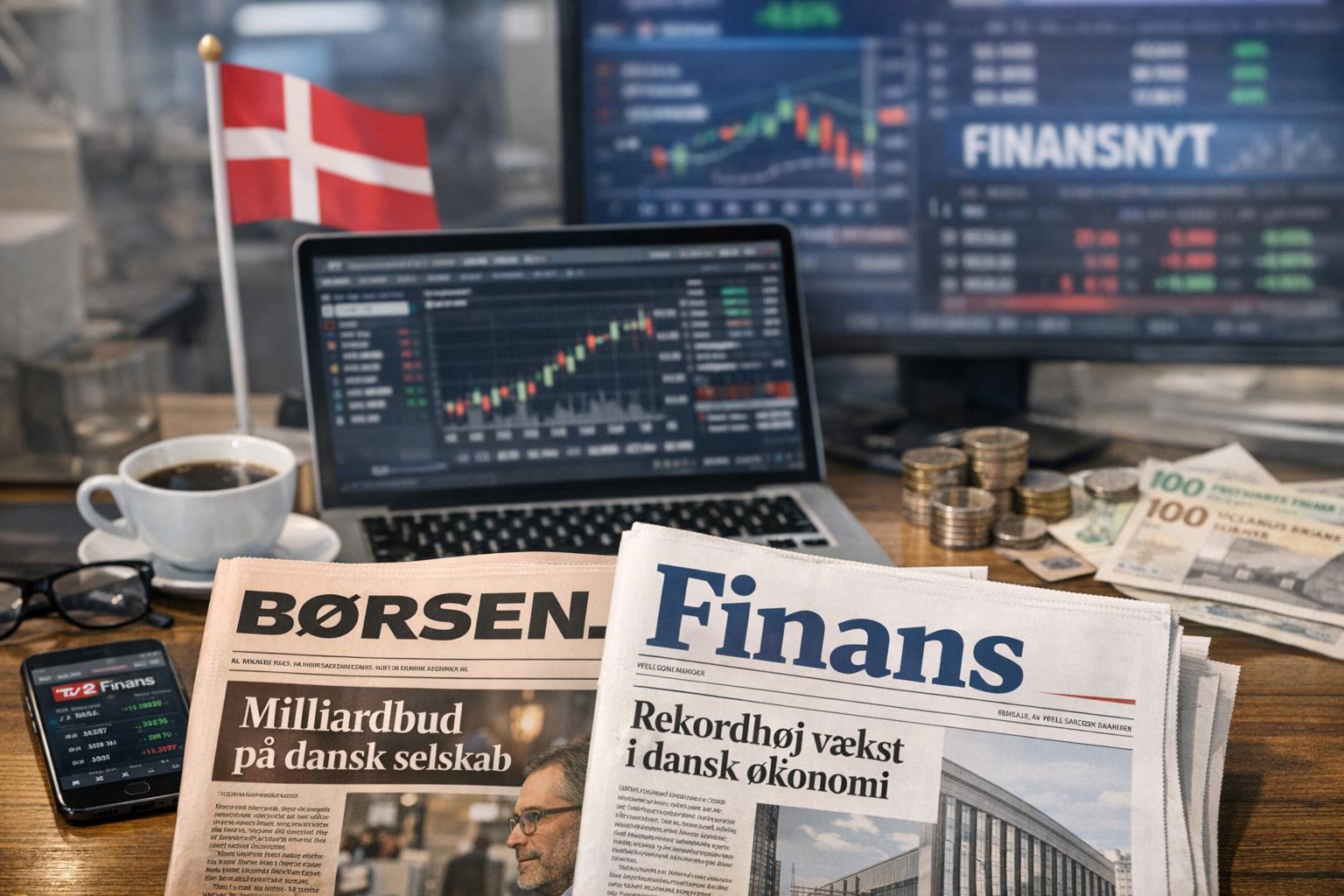
The most prominent dedicated financial newspaper in Denmark is Børsen, founded in 1896. Published by Børsen, it is headquartered in Copenhagen and remains the only daily newspaper in Denmark exclusively focused on business and finance. Its editorial scope includes equity markets, macroeconomic developments, corporate strategy, executive leadership, private equity activity, taxation, and personal finance.
Børsen operates primarily under a subscription-based model and has invested heavily in digital infrastructure. Its website provides real-time news updates, analysis, sector overviews, and company databases. A significant portion of its revenue now stems from digital subscriptions rather than print circulation. Conferences, executive events, and specialized rankings also contribute to its commercial model, reinforcing its influence within the Danish corporate community.
Major general-interest newspapers maintain strong financial desks. Politiken, Berlingske, and Jyllands-Posten integrate business reporting into broader political and societal coverage. Their economic journalism often connects fiscal policy decisions to social impacts, housing markets, labor negotiations, and climate transition costs. Because these newspapers serve broad audiences, their financial coverage frequently balances corporate reporting with consumer-oriented content.
Digital-native outlets have added further specialization. Platforms focusing on technology entrepreneurship, venture capital ecosystems, and startup financing address narrower professional communities. These outlets often use hybrid revenue streams combining paid subscriptions, data tools, sponsorships, and partnerships with industry associations.
International financial news providers also maintain influence. Danish professionals regularly access Bloomberg, Reuters, and global publications. Nevertheless, domestic financial outlets retain competitive advantage in detailed reporting on Danish-listed companies and regulatory frameworks.
Role of Public Service Broadcasters
Public service media plays an important role in Denmark’s media system. DR (Danmarks Radio) and TV 2 provide extensive coverage of economic developments within general news programming. Although neither is solely focused on financial markets, their reporting significantly shapes public understanding of inflation, interest rates, employment data, and government budgets.
Public service journalism tends to emphasize explanatory reporting. When the Danish central bank adjusts interest rates or when new fiscal budgets are announced, broadcasters provide contextual analysis of implications for households, mortgages, pensions, and employment. Graphics, expert interviews, and long-form background segments support public comprehension of complex financial issues.
These broadcasters operate under regulatory frameworks designed to ensure independence, accuracy, and impartiality. Funding structures differ, with DR financed through public mechanisms and TV 2 operating under a combination of advertising revenue and regulated public service obligations. Both institutions have strong digital presences, offering streaming, on-demand segments, and online articles that include financial coverage.
During periods of economic stress, such as the 2008 global financial crisis and subsequent eurozone instability, public broadcasters expanded economic reporting. Explanations of bank recapitalizations, mortgage bond markets, and fiscal stimulus measures contributed to general awareness of systemic financial risks.
Digital Transformation and Subscription Models
Denmark consistently ranks among Europe’s most digitally connected societies. High broadband coverage, near-universal smartphone penetration, and digital government services create favorable conditions for online journalism. Financial media has responded by restructuring business models away from heavy dependence on print advertising.
Subscription-based digital access is central to revenue generation. Paywalls, premium analysis tiers, and specialized newsletters are common features among financial outlets. Danish readers demonstrate above-average levels of trust in domestic media brands, supporting willingness to pay for digital content.
Technology integration has also changed content delivery. Financial platforms now incorporate live market dashboards, searchable financial statements, stock screening tools, and automated alerts. Readers expect near real-time coverage of earnings releases and regulatory announcements. Editorial teams coordinate closely with technical developers to maintain integrated data environments.
Podcasting has emerged as a complementary channel. Leading newspapers and financial outlets produce recurring shows focusing on market trends, corporate governance debates, and macroeconomic forecasts. Audio formats extend engagement beyond written articles and attract professional audiences seeking in-depth discussions.
Algorithmic personalization and data analytics assist publishers in understanding reader preferences. However, editorial standards continue to emphasize professional judgment rather than purely traffic-driven priorities, reflecting the reputational importance of accuracy in financial reporting.
Regulatory Environment and Media Ethics
Financial journalism intersects with both media regulation and financial market law. The Danish Press Council oversees ethical complaints, promoting standards of accuracy, source transparency, and fairness. Journalists are expected to verify corporate claims, contextualize data releases, and provide balanced perspectives when reporting on disputes.
Market-sensitive information presents particular challenges. Reporting on publicly traded companies requires caution to avoid disseminating incorrect or misleading information that could influence share prices. Editors often coordinate with legal advisers when handling sensitive leaks or confidential materials.
Denmark’s regulatory environment for financial markets aligns with European Union frameworks, including market abuse regulations. Journalists must understand these frameworks to report accurately on insider trading cases, compliance investigations, and enforcement actions.
Institutional trust in Denmark remains relatively strong compared to many countries. Nevertheless, financial journalists face ongoing challenges, including access to corporate executives, interpretation of complex derivatives or tax structures, and rapid developments in global capital markets.
Coverage of the Danish Corporate Sector
Denmark hosts several globally significant corporations whose activities shape national economic reporting. Maersk, a major shipping and logistics company; Novo Nordisk, a pharmaceutical leader; Vestas, active in wind turbine manufacturing; Ørsted, focused on renewable energy; and Carlsberg, operating in the brewing sector, regularly feature in domestic financial news.
Quarterly earnings reports generate detailed analysis covering revenue growth, operating margins, cost developments, and forward guidance. Journalists also report on mergers and acquisitions, strategic realignments, research investments, and executive appointments. Because many Danish companies derive significant revenue from international markets, coverage routinely connects global economic shifts to domestic corporate performance.
Environmental and sustainability considerations are prominent themes. ESG (Environmental, Social, and Governance) frameworks influence investor decision-making, and Danish companies are often evaluated against decarbonization strategies and governance standards. Financial media assesses these strategies in relation to both regulatory requirements and global investor expectations.
Small and medium-sized enterprises receive attention, particularly in reporting on export initiatives, digital transformation, and regional business ecosystems. Innovation clusters in life sciences, renewable energy, and information technology contribute additional reporting avenues.
The Danish Welfare Model and Economic Debate
Economic journalism in Denmark cannot be separated from the country’s welfare model. Public expenditure levels, taxation structures, and labor market agreements are central to political and financial reporting. Journalists analyze fiscal sustainability, demographic changes, and pension obligations within long-term budget frameworks.
The labor market’s “flexicurity” structure, balancing flexible hiring and dismissal practices with social safety nets, attracts regular analytical coverage. Negotiations between employer federations and labor unions are reported in financial terms, addressing wage growth, productivity, and competitiveness.
Pension funds, including ATP and PFA, manage significant assets relative to national GDP. Their investment strategies in infrastructure, real estate, private equity, and international equities receive detailed media attention. As large institutional investors, these funds also influence corporate governance practices domestically and abroad.
Housing finance represents another key issue. Denmark’s mortgage bond system, historically considered stable and transparent, is widely covered in financial journalism. Interest rate adjustments by Danmarks Nationalbank directly affect homeowners, and media analysis frequently examines implications for property prices and household debt levels.
The Copenhagen Stock Exchange and Market Reporting
The Copenhagen Stock Exchange, integrated into the Nasdaq Nordic group, functions as the primary marketplace for Danish listed equities. Daily reporting includes index performance, sector comparisons, and analysis of trading volumes. While Denmark’s market capitalization is modest compared to larger European exchanges, certain sectors such as pharmaceuticals and renewable energy hold international significance.
Financial journalists contextualize domestic stock movements within broader global movements, referencing developments in European and U.S. markets. Reporting frequently cites international sources such as Reuters and Bloomberg for comparative data and global macroeconomic updates.
Initial public offerings, delistings, and secondary share placements receive detailed scrutiny. Analysts’ recommendations and investment bank forecasts are reported with attention to potential conflicts of interest and market sensitivities.
Alternative Formats and Emerging Trends
Financial content increasingly appears through newsletters, invitation-only webinars, and professional briefings. These formats allow outlets to target segmented audiences, including private investors, institutional asset managers, and corporate executives. Subscription newsletters often provide early-morning market summaries or thematic deep dives into sectors such as biotechnology or green energy financing.
Social media has accelerated dissemination of financial headlines. Danish journalists use professional platforms to share breaking news and analysis. However, traditional editorial oversight remains central to maintaining credibility, particularly when reporting on price-sensitive developments.
Artificial intelligence and data automation tools are gradually entering newsrooms. Automated earnings summaries and statistical visualizations reduce production time, allowing reporters to focus on investigative and analytical tasks.
Challenges and Competitive Pressures
Structural pressures in the global media industry also affect Danish financial journalism. Digital advertising revenue frequently flows to multinational technology platforms rather than domestic publishers. Sustaining investigative reporting capacity requires continued subscription growth and efficient cost management.
The increasing technical complexity of financial instruments presents another challenge. Coverage of derivatives, algorithmic trading systems, cross-border tax structures, and climate-related financial disclosures necessitates specialized expertise. Media organizations invest in recruitment and ongoing training to preserve analytical depth.
Competition from international sources remains significant. Professionals often consult English-language outlets alongside Danish publications. Domestic media therefore emphasize local expertise, direct access to Danish decision-makers, and regulatory familiarity.
International Orientation of Danish Financial Media
Denmark’s export-driven economy ensures that global developments feature prominently in financial reporting. Monetary policy decisions by the European Central Bank and the U.S. Federal Reserve influence Danish interest rate conditions due to exchange rate arrangements and financial linkages. Trade disputes, supply chain disruptions, and geopolitical tensions receive systematic analysis regarding their potential impact on Danish corporates.
Brexit negotiations, EU fiscal coordination, and trade relations with Asia and North America have been recurring themes. Danish journalists frequently collaborate with international correspondents and rely on global data providers for real-time information.
Cross-border investments by Danish pension funds and corporations further internationalize coverage. Infrastructure investments in North America, renewable energy projects in Asia, and pharmaceutical market expansion in the United States all extend the geographical reach of domestic financial journalism.
Conclusion
Financial media in Denmark constitutes a specialized yet integrated segment of the national media system. Anchored by institutions such as Børsen, complemented by major national newspapers and supported by public service broadcasters, Danish financial journalism combines domestic focus with global awareness.
The sector has adapted to digital transformation through subscription-based models, data integration, and multimedia expansion. At the same time, it operates within a robust ethical and regulatory framework emphasizing transparency and factual accuracy. Coverage extends beyond stock prices to encompass welfare state financing, pension investment strategies, sustainability transitions, and international economic developments.
Although Denmark is small in population terms, its globally active corporations, substantial pension assets, and open economy generate sustained demand for professional financial reporting. The development of Danish financial media illustrates how a highly digitalized and institutionally stable country maintains a resilient and adaptive business journalism sector within the broader European context.