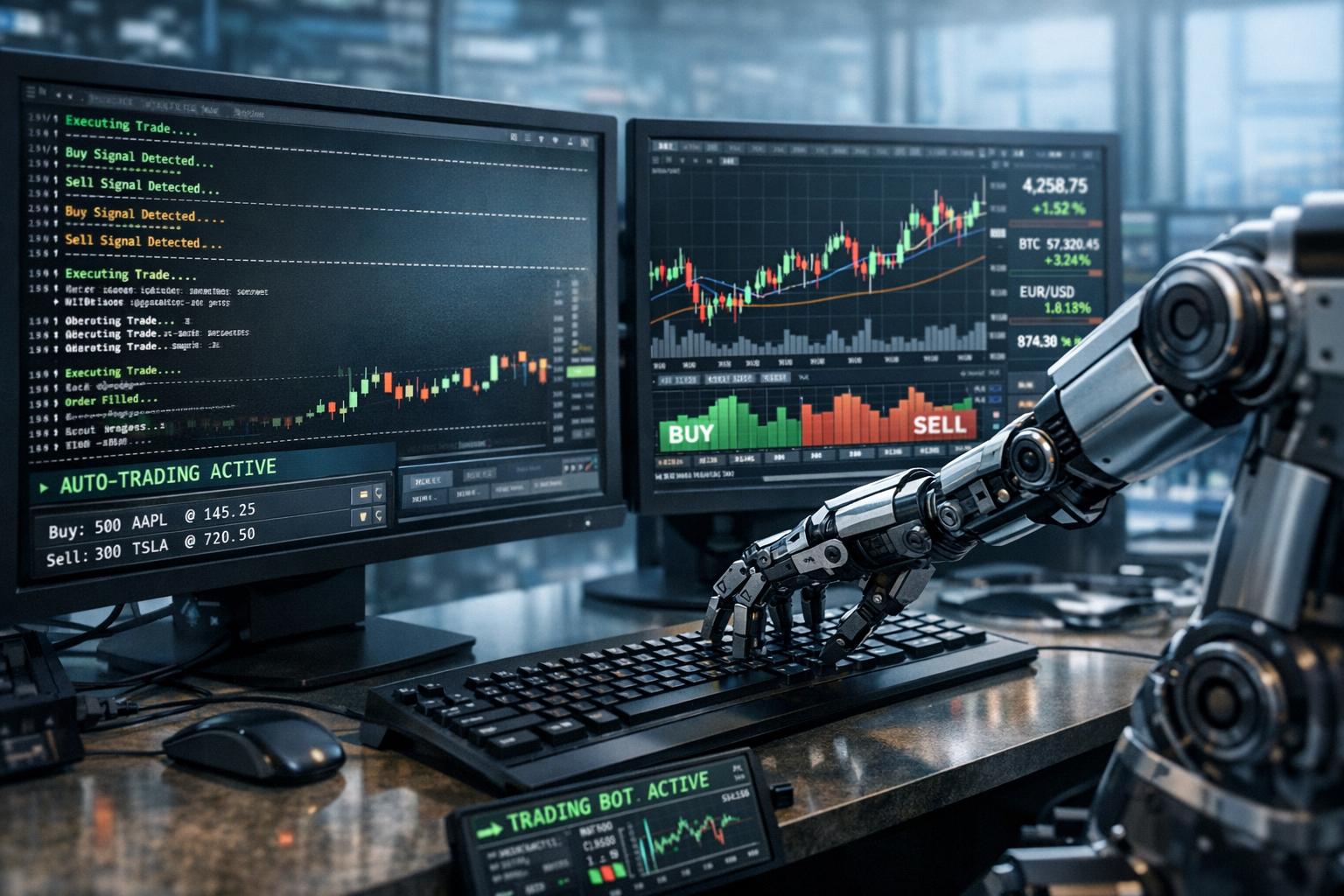
Automated trading refers to the use of computer programs to execute financial market transactions based on predefined rules. These systems, often described as algorithmic trading or systematic trading, operate with minimal or no human intervention once deployed. They are widely used across asset classes including equities, foreign exchange, commodities, futures, options, fixed income instruments, and increasingly digital assets.
The core idea behind automated trading is straightforward: identify a set of rules that define when to enter and exit positions, translate those rules into code, and allow a computer to monitor markets and execute trades accordingly. While the concept appears simple, the implementation can involve complex mathematical models, high-performance computing infrastructure, detailed transaction cost modeling, and structured risk management processes. The evolution of this approach has significantly altered market structure, liquidity provision, and the operational model of brokerage services.
Historical Development of Automated Trading
Automated trading evolved alongside advances in electronic markets and computing power. In early financial markets, transactions were conducted manually on physical trading floors where human intermediaries matched buyers and sellers. Communication was limited by physical proximity and verbal interaction, and order execution required direct coordination between brokers and specialists.
The transition toward electronic order routing in the late twentieth century created the structural conditions necessary for computer-driven execution. The introduction of electronic communication networks reduced reliance on floor-based processes and enabled participants to submit orders digitally. As computing costs declined and connectivity improved, it became feasible to automate repetitive aspects of execution.
During the 1990s, institutional investors began adopting algorithmic systems primarily to manage large orders more efficiently. Large block trades could significantly affect prices if executed all at once. Early execution algorithms were designed to reduce market impact by slicing orders into smaller components and distributing them over time. These algorithms focused on minimizing deviation from benchmark prices.
In the early 2000s, quantitative hedge funds expanded the use of automated systems beyond execution efficiency. Statistical arbitrage, pairs trading, and model-driven asset allocation strategies grew in prominence. As data storage and processing capacity expanded, more complex models could be developed and tested on historical datasets.
Today, automated trading accounts for a substantial share of turnover in many developed markets. High-frequency trading firms, proprietary trading desks, asset managers, and even retail participants rely on automation to varying degrees. The technology continues to evolve in response to competition, regulation, and innovation in computing.
Market Structure and the Rise of Electronic Execution
The emergence of automated trading cannot be separated from changes in market structure. Decimalization of stock prices, the proliferation of alternative trading systems, and fragmentation of liquidity across multiple venues significantly increased execution complexity. Traders seeking the best available price had to evaluate numerous exchanges and liquidity pools simultaneously.
This environment encouraged the development of smart order routing systems capable of scanning multiple venues and directing orders to the most favorable destination. Automated decision-making became essential because manual routing could not process venue-specific fee structures, rebates, and real-time liquidity conditions with comparable speed.
In derivatives and foreign exchange markets, electronic platforms replaced voice brokerage to a large extent. Continuous, centralized data feeds enabled automated strategies to monitor spreads and correlations across instruments in real time. As global connectivity improved, cross-border trading also became more integrated, further encouraging systematic methods.
Core Components of an Automated Trading System
An automated trading framework typically consists of several tightly integrated components. At its center lies the strategy engine, where trading logic is implemented. This engine processes incoming data and evaluates predefined conditions for trade entry, exit, position sizing, and portfolio balancing.
The strategy engine depends on market data feeds. These feeds provide information such as last traded price, bid and ask quotations, trade volume, order book depth, corporate actions, and economic announcements. Data may be delivered at varying frequencies, from end-of-day summaries to tick-level updates measured in milliseconds. Data normalization, filtering, and synchronization are essential to ensure accuracy.
The order management system bridges strategy signals and the external market. It converts trading decisions into specific order instructions, selects order types, manages partial fills, and tracks execution status. It may incorporate logic to modify or cancel orders dynamically in response to changing conditions.
Risk management modules operate both before and after order placement. Pre-trade controls verify compliance with position limits, leverage constraints, and regulatory requirements. Post-trade controls monitor exposures in real time, calculating metrics such as value at risk, drawdown, and margin utilization. If certain thresholds are breached, automated controls may restrict additional trading.
Supporting these components are logging systems, performance analytics tools, and auditing frameworks that record activity for compliance and evaluation purposes. Reliable architecture requires redundancy, failover mechanisms, and secure data handling protocols.
Types of Automated Trading Strategies
Automated strategies vary according to time horizon, asset class, and theoretical foundation. Trend-following systems attempt to capitalize on sustained directional price movement. They often rely on moving averages, breakout thresholds, or momentum indicators. The principle assumes that once a price trend is established, it may persist for a measurable period.
Mean reversion strategies assume that extreme price deviations from an average or equilibrium level are temporary. Statistical measures such as standard deviation bands or z-scores may be used to identify overextended conditions. These systems generally require disciplined exit parameters to avoid sustained losses during structural shifts.
Arbitrage strategies focus on price discrepancies between related instruments. Examples include index arbitrage, exchange arbitrage, and curve arbitrage in fixed income markets. Opportunities may be brief and require rapid execution to capture minimal spreads before prices converge.
Market-making systems provide continuous bid and ask quotations, seeking to profit from the bid-ask differential. The strategy relies on efficient inventory management, dynamic pricing adjustments, and rapid response to order flow imbalances. In electronic markets with fragmented liquidity, automated market-making is common.
Portfolio-level strategies integrate asset allocation rules with dynamic rebalancing. These may incorporate macroeconomic indicators, volatility targeting, or risk parity methodologies. Orders are generated not from single-instrument signals but from broader portfolio optimization processes.
The increased availability of large datasets has contributed to the growth of machine learning-based strategies. Supervised learning models can be trained on historical observations to classify short-term direction or forecast volatility. Unsupervised methods may detect structural patterns in market regimes. Careful model validation is necessary to ensure predictive relevance.
Infrastructure and Technology Requirements
The infrastructure supporting automated trading must align with the intended time horizon. High-frequency strategies rely on ultra-low-latency systems. These often involve co-located servers within exchange data centers, high-speed network interfaces, and specialized hardware components designed for rapid data processing.
Latency-sensitive trading may use programming languages such as C++ optimized for execution speed. Conversely, medium- and long-term strategies frequently utilize Python due to its flexibility and extensive data science libraries. In production environments, hybrid architectures are common, combining research code with performance-optimized execution layers.
Reliable connectivity to brokerage infrastructure is essential. Automated systems often interact with brokers through dedicated application programming interfaces. These interfaces provide access to order placement, account information, margin data, and execution confirmations. Firms typically implement redundant internet connections and backup servers to mitigate downtime risk.
Cloud computing resources have become more prevalent for research and large-scale simulations. Distributed computing frameworks allow parallelized backtesting across numerous parameter combinations. However, latency constraints may limit cloud usage for strategies requiring immediate market response.
Backtesting and Strategy Validation
Backtesting plays a central role in evaluating automated trading systems. Historical data is used to simulate how a strategy would have performed under previous market conditions. Researchers examine cumulative returns, risk-adjusted metrics, drawdown statistics, and exposure patterns.
Accurate backtesting requires high-quality data adjusted for corporate actions, contract rollovers, and survivorship bias. Data integrity errors can lead to misleading conclusions. Additionally, the simulation must replicate realistic order execution assumptions, including partial fills and order queue positioning where applicable.
Overfitting is a persistent challenge. When too many parameters are optimized against past data, a strategy may capture random fluctuations rather than persistent patterns. To address this issue, practitioners employ out-of-sample testing and walk-forward analysis, separating development data from evaluation data.
Transaction costs and slippage must be incorporated to approximate real-world profitability. For short-term strategies, even small variations in execution assumptions can materially affect outcomes. Stress testing under different volatility regimes and liquidity conditions provides further insight into robustness.
Risk Management in Automated Trading
Risk management extends beyond individual trades to the overall portfolio and operational framework. Automated systems can generate large volumes of orders in a short time, amplifying unintended exposures if safeguards are absent.
Common mechanisms include position limits, maximum order size restrictions, and predefined stop-loss levels. Portfolio-level controls may cap leverage or restrict sector concentration. Loss limits applied on a daily or intraday basis can trigger trading suspension once reached.
Operational risk management addresses software reliability and infrastructure stability. Code reviews, staged deployment, and continuous monitoring are standard practices. Real-time alerts notify operators of abnormal patterns such as excessive order rejections or latency spikes.
Model risk is another dimension. Quantitative assumptions may fail under structural market changes. Periodic model review and recalibration help ensure that strategies remain aligned with prevailing conditions.
Regulatory Environment
Regulators oversee automated trading to preserve fair and orderly markets. Requirements often include pre-trade risk controls, comprehensive audit trails, and clear documentation of algorithmic logic. Firms may be required to certify that systems can be deactivated promptly if malfunctions occur.
Market surveillance mechanisms monitor manipulative practices such as spoofing or layering. Automated strategies must comply with order-to-trade ratio limitations and minimum resting times where applicable. In some jurisdictions, firms engaging in high-frequency trading must maintain additional capital or registration status.
Regulatory developments continue to evolve as technology advances. Authorities assess systemic risk implications, particularly during episodes of rapid market movement in which algorithmic interactions may accelerate price changes.
Advantages of Automated Trading
A central advantage of automated trading is rule consistency. Once parameters are defined, trades are executed according to objective criteria without discretionary deviation. This limits behavioral biases that can influence manual decisions.
Automation also enables simultaneous monitoring of numerous instruments. A systematic framework can analyze cross-asset relationships and execute coordinated trades with speed and precision. Scalability permits expansion into additional markets without proportional increases in staffing.
Detailed performance analytics provide transparency. Every order, modification, and fill is recorded digitally, supporting systematic evaluation and refinement.
Limitations and Challenges
Automated systems are sensitive to changing market dynamics. Structural shifts in liquidity, regulation, or participant behavior may reduce strategy effectiveness. Continuous adaptation and research are required to sustain performance.
Competition among quantitative participants compresses available inefficiencies. Widely adopted signals may lose predictive strength as more capital employs similar models. Capacity constraints can also arise, particularly in less liquid instruments.
Development demands interdisciplinary expertise. Knowledge of financial theory, statistics, programming, and infrastructure management is necessary for comprehensive implementation. Data acquisition and maintenance represent ongoing costs.
Applications Across Market Participants
Institutional investors apply automated execution algorithms such as volume-weighted average price and time-weighted average price to manage large transaction flows efficiently. These tools aim to achieve benchmark-aligned execution while controlling costs.
Hedge funds deploy proprietary quantitative models seeking absolute returns. Some integrate discretionary oversight, allowing portfolio managers to adjust exposure during unusual market conditions. Others rely on fully systematic frameworks governed by statistical triggers.
Retail traders have gained access to automation through brokerage platforms offering scripting environments and APIs. While technological barriers have declined, disciplined testing and capital management remain critical to sustainability.
Future Directions
The trajectory of automated trading reflects broader technological progress. Advances in artificial intelligence, distributed computing, and data acquisition expand analytical possibilities. Enhanced real-time analytics support more granular risk monitoring and portfolio optimization.
Cross-asset integration continues to deepen, linking equities, derivatives, foreign exchange, and digital assets within unified systems. As financial markets become more interconnected globally, automated strategies must account for correlations that transcend traditional boundaries.
Ongoing collaboration between industry participants and regulators shapes standards for transparency and control. The balance between innovation and systemic stability remains central to policy discussions.
In summary, automated trading represents a structural evolution in financial markets. By converting trading methodologies into executable code, participants can operate with efficiency, consistency, and scalable reach. Effective deployment depends on rigorous validation, resilient infrastructure, disciplined risk management, and continuous adaptation to evolving market environments.